

Few people know that Alberto Angela, paleontologist, scientific popularizer, television presenter, journalist, and Italian writer, in the early 1980s, when he was still eighteen, discovered his first vocation and entered Capannelle - Central Fire Schools of the Fire Brigade in Rome, to train and undertake work as a firefighter. Driven by his passion for this first job, in November 2020, in its first edition, he wrote and presented the first book of the Nero trilogy - The Last Day of Rome - A Journey into Nero's City Just Before the Great Fire. In this first book, he gives us a historical narrative with a cinematic, incredibly engaging style, unique in its genre, which, among other things, also managed to provide a significant contribution to the Historical Museum of Firefighters and the Italian Red Cross in Manfredonia. He gave us details on how the Roman Vigiles operated, how they were dressed, and equipped on the night of the fire. During their patrol, the two Vigiles on duty, the mighty veteran Vindex and the very young recruit Saturninus, were carrying out a fundamental job for the order and safety of the population of Rome, a city where fire was used for everything and tragedy was always lurking. Their daily work in that Rome, largely made of wood with shops full of flammable goods facing the streets, was of vital importance. Based on archaeological data and ancient sources, and thanks to the contribution of historians and experts in meteorology and fire, Alberto Angela reconstructs for the first time in history, the very important episode that forever changed the geography of Rome and our history: the Great Fire of 64 AD. That night, the Vigiles (the word Vigiles encompassed all the hard work of this profession, that is, patrolling and guarding (keeping vigil) the streets of Rome during the night. The Vigiles were almost all very young, between teenagers and twenty-year-olds. The military imprint of the Corps of Vigiles clearly emerged in their uniform and from the helmet that vaguely resembled that of the legionaries. The helmet was not made of bronze or steel, but of leather, because unlike metal, it did not conduct the radiant heat of fire. The tunic, since there was no uniform industrial production, was of a different color even among them and varied between yellow and brown, which, in the reflection of the flames, shone yellow. Each tunic was cinched at the waist by a leather belt (cingulum) with some thick leather fringes that descended between the thighs to protect the intimate parts. From the belt of almost all of them hung axes (securis), a double-headed tool very similar to the dolabra, with a sharp blade on one side and a point on the other, to be used as an axe or as a pickaxe to knock down walls, break down wooden doors, dig the earth, etc. Curious, however, were the buckets, which were not made of metal; in fact, most scholars believe they were made of rush wood, smeared with pitch to make them waterproof. In addition to these tools, essential for an initial intervention in a fire, there were also weapons because, having to patrol the streets at night, hunt criminals or fugitive slaves, they had to be armed and, not having motorized vehicles and having to carry everything on them for hours, all the fire-fighting equipment had to be essential, not bulky, and light. Many of them carried long hemp ropes (funes) over their shoulders, which they wrapped around their torso like a snake in several turns. Just like the legionaries, in winter they also wore a cloak (sagum), inconceivable on that July night due to the summer heat. They wore what looked like military "amphibious" boots to protect their feet, a kind of soft leather ankle boot (soccus) inserted like a sock inside a sturdy military sandal with a studded sole (caliga), a type of footwear, composed of two pieces, found incredibly intact on board the famous Roman wreck of Comacchio, and which must have constituted the classic amphibious boot of the legionaries, capable of protecting their feet from thorns, snow, cold, and rain, and it could not be ruled out that it was an excellent solution to resist fire as well. This reconstruction of the Vigiles' uniform is unfortunately hypothetical, because no contemporary author has ever described it in detail, but judging by the numerous ancient and modern sources, it seems plausible. The number of Vigiles on patrol that night is also hypothetical. However, since the night was a risky shift during which the Vigiles also performed police duties, with the obligation to quell brawls and arrest criminals and thieves, a relatively small number consisting of eight men, i.e., the basic unit of the legion (the famous contubernium, i.e., men who shared the same tent and the same line during marches), seems a sensible hypothesis.
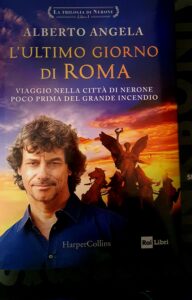 This is a summary of the thrilling story of the Roman Vigiles who fought for nine days (other scholars speak of seven days and seven nights) to extinguish the flames that, from Saturday, July 18 to Sunday, July 26, 64 AD, destroyed Rome, causing the complete loss of three districts while seven others were damaged, resulting in thousands of deaths and 200,000 homeless survivors.
With these valuable indications provided by Alberto Angela, the hypothetical history of the fire of Rome, the uniform worn during those fateful days in Rome, and the operational methods of the two Vigiles Vindex and Saturninus have been improved at the Historical Museum of Firefighters and the Italian Red Cross, which students of all levels and all visitors will be able to admire in the Museum.